

The Notre Dame faculty members who attended COP30 all had their own reasons for wanting to attend the annual United Nations climate summit. Daniele de Almeida Miranda (Biological Sciences) wanted to see how research like hers was put into action. Sandra Vera-Muñoz (Mendoza College of Business) wanted to be “in the room where it happens,” Hamilton-style, and link what she’d learn back to her research and teaching. For Marcio Bahia (Arts & Letters), it was about updating and enhancing his courses, and it helped that the conference was happening in his hometown—Belém, Brazil.
The international conference was a packed, 12-day event. Despite being a long way from South Bend, Our Lady’s University had an interdisciplinary representation through Miranda, Vera-Muñoz, and Bahia. “It was a nice combination because I am interested in the social side of the discussion, Professor Miranda is interested in the more ecological side of the discussion, and Professor Vera-Muñoz is on the business side of things. And they all go together,” Bahia says.
Notre Dame has been attending the Conference of the Parties (COP) of the United Nations Framework Convention on Climate Change (UNFCCC) on and off since 2017, when the Notre Dame Global Adaptation Initiative (ND-GAIN), a program within the Notre Dame Environmental Change Initiative, first became ratified as an observer. Notre Dame Global now holds the Observer Status passes, and ensures that interested faculty have the opportunity to attend each year. And as Bahia points out, it’s important that they take that opportunity. “If Notre Dame wants to be the Catholic global university leader, it has to be on the forefront of this discussion. We cannot be outside that discussion. So professors from different areas, they have to go there and they have to see what the world is doing and be part of that process.”
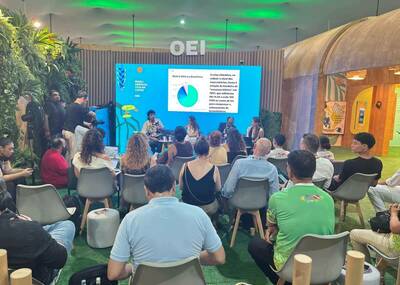
While the purpose of the conference is to gather countries together to negotiate and agree on plans for addressing climate change, for Notre Dame attendees, it’s an important opportunity to not only represent the University but make connections. As the conference attracts experts from all over the world, COP30 presented an excellent environment to network and meet people in their related fields. “What was really nice was the shared understanding that we all have common goals in protecting the Earth,” Vera-Muñoz shares. “I was really pleasantly surprised at that sense of solidarity, collegiality, and intellectual curiosity about what everybody was doing.”
The Notre Dame faculty members got to attend lectures at the pavilions hosted by countries from around the world, connect with NGOs from the US, and sit in on negotiations for the different climate decisions and initiatives. “It was really awesome to see how the topics that I'm discussing in the classroom are real topics that are being discussed in the negotiations,” says Miranda.
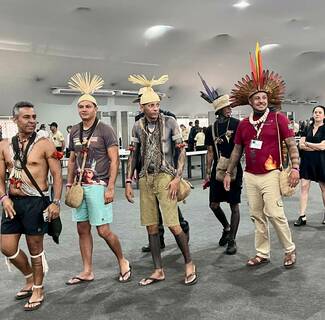
Just as important as their presence at the conference is what these faculty members bring back to campus. For Bahia, he left with what he was looking for—and more. Not only does he have the knowledge and resources to update his course that features a section on land conflict in the Amazon, but he also left inspired to create a new course about the human side of the climate crisis. “Going to COP was a perfect opportunity to see how those two things, the land conflict and the human side of the land conflict, go with climate change.” The significance of the “human side” was made especially clear to Bahia by the presence of so many indigenous communities leading peaceful protests at COP. Vera-Muñoz assented, emphasizing how their presence was a revelation. “You can read all you want about it, but until you see with your own eyes the gravity of this situation, that's the only way that you can really appreciate how everything is interconnected.” For her, the message of climate justice rang loud and clear witnessing their stand.
As a Brazilian, something that was an important takeaway for Miranda was maintaining and building her connection to her home country in her research—and tying it more closely to climate work. “COP30 and the pre-COP conference brought me this wish to be more connected to Brazilian researchers,” she says, reflecting on the conversations she had and the knowledge she gained. “I realized that my work with environmental contaminants has to be combined with climate change because with natural events being stronger now, they're going to spread more contaminants. They're going to cause more issues to the environment that will impact not only the environment, but the people. I want to bring this all to my research.”
Vera-Muñoz hit the ground running when she returned to her classroom this semester. “I started talking about COP30 on the first day of class, and I will continue to do that for the rest of the semester.” She shares that one of the most impactful talks she attended was one given by former US Vice President Al Gore. He was there to introduce Climate TRACE, an online greenhouse gas (GHG) emissions inventory portal that uses satellite technology and AI to estimate where GHG emissions are coming from at the facility level worldwide “The best part is that the data is free, which is a big deal,” she says. Not only is this data that Vera-Muñoz could benefit from, but it will be an excellent tool for her students in their capstone projects.

In addition to offering them tools, a lesson she wants to impart on her students is the importance of information integrity—a constant challenge when it comes to matters of reporting on the impacts of climate change, and COP30 was no exception. “My job is to make sure that the generations who are going to be dealing with these challenges know how to address disinformation and misinformation.”
Ultimately, the summit proved to be eye-opening and impactful, the faculty members concurred. “It was a privilege to attend this COP specifically because it was in the Amazon,” Bahia says, “Talking about the Amazon in the Amazon with Amazonian actors in and around—that was very important, that was historic.”
As the world around us continues to experience the impact of climate change, it’s encouraging to know that Notre Dame leaders are gathering with others at the frontlines—and bringing what they learned back to their classrooms and research to inform and inspire the next generation of changemakers.
Originally published by at global.nd.edu on January 30, 2026.